Prompt Content
REFERENCE IMAGE 1 STRENGTH 100, REFERENCE IMAGE 2 STRENGTH 100, FACE ID LOCK 100, CHARACTER CONSISTENCY 100, IDENTITY PRESERVATION PRIORITY MAXIMUM.
Use the first uploaded image as the exact male face reference and the second uploaded image as the exact female face reference. Preserve 100% facial identity, face shape, jawline, skin tone, hairstyle, eyebrows, eyes, nose, lips, facial structure, expression style, and overall appearance of both individuals. Do not alter age, ethnicity, or recognizable facial characteristics.
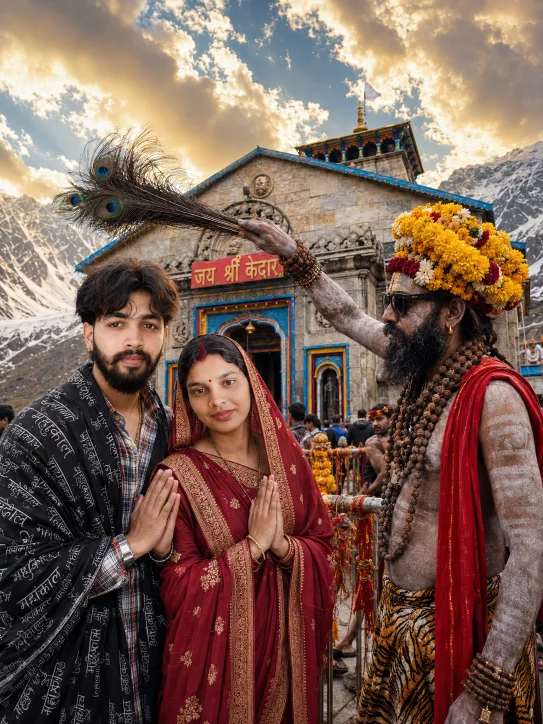
Create an ultra-realistic 8K cinematic portrait of a young Indian couple standing together outside the sacred Kedarnath Temple. The couple stands respectfully with folded hands in a traditional namaste pose while receiving blessings from a powerful ash-covered sadhu.
The sadhu wears dark sunglasses, multiple Rudraksha bead necklaces, a grand yellow and red marigold floral crown, sacred ash on his body, a red cloth draped over one shoulder, and a tiger-print lower garment. He holds a bundle of peacock feathers above the couple’s heads in a divine blessing gesture.
The young man wears a luxurious black shawl heavily draped over his shoulders, richly printed with white Sanskrit “महाकाल” calligraphy and sacred symbols, layered over a stylish red, white, and grey oversized plaid shirt, loose black jeans, silver chain necklace, wristwatch, and ear piercing. His forehead features a broad yellow sandalwood tilak with bright red “ॐ महाकाल” written naturally over it.
The young woman stands beside him wearing an elegant traditional red saree with rich golden embroidery, matching veil over her head, traditional necklace, earrings, bangles, small red bindi, sindoor, and graceful smile. Her saree fabric should display realistic folds, embroidery details, and premium textures.
Behind them stands the magnificent stone architecture of Kedarnath Temple with highly detailed carvings. The entrance is decorated with vibrant blue and yellow colors and a red sign displaying “जय श्री केदार”. Sacred barricades wrapped in red and yellow threads, marigold flower garlands, temple bells, and crowds of pilgrims create a vibrant devotional atmosphere.
Massive snow-covered Himalayan mountains rise behind the temple. Dramatic clouds fill the sky while golden divine sunlight breaks through the clouds, creating volumetric god rays. Cinematic lighting, HDR photography, realistic skin pores, natural facial details, ultra-detailed clothing textures, realistic shadows, depth of field, professional color grading, spiritual atmosphere, National Geographic photography quality, hyper-realistic, masterpiece composition, ultra-sharp focus, photorealistic, 8K resolution.
Aspect Ratio: 3:4
Negative Prompt
face distortion, face swap error, wrong identity, different person, low quality, blurry, pixelated, cartoon, anime, CGI, 3D render, duplicate faces, extra people, extra fingers, extra hands, extra limbs, bad anatomy, malformed hands, deformed eyes, crossed eyes, unrealistic skin, plastic skin, poor lighting, overexposed, underexposed, low detail, bad clothing texture, distorted temple, modern buildings, vehicles, western outfits, sci-fi elements, fantasy creatures, text artifacts, watermark, logo, signature, cropped faces, cropped body, duplicate jewelry, unrealistic shadows, noisy image, compression artifacts, motion blur, low resolution, ugly composition, incorrect tilak, unrealistic saree, inaccurate facial features, face mismatch.
A Sacred Kedarnath Portrait of Love, Faith, and Blessings
Some photographs capture a moment, while others attempt to capture an emotion that feels much larger than the moment itself. This concept brings together a young Indian couple, a traditional sadhu, the sacred atmosphere of Kedarnath Temple, and the majestic Himalayas to create a cinematic portrait centered around faith, togetherness, devotion, and spiritual blessing.
The composition is designed as an ultra-realistic 8K-style cinematic portrait in a vertical 3:4 format, with the couple standing respectfully before the temple while receiving a blessing from the sadhu. Every major element—from facial identity and traditional clothing to the temple architecture and Himalayan landscape—is intended to contribute to one cohesive visual story.
Two Identities, One Visual Story
The first reference image establishes the exact identity of the young man, while the second reference image establishes the exact identity of the young woman.
Their individual facial characteristics are intended to remain consistent, including face shape, jawline, skin tone, hairstyle, eyebrows, eyes, nose, lips, facial proportions, and recognizable features.
This is especially important in a couple portrait because both individuals need to remain visually recognizable. Changing either person’s facial structure could make the scene feel like a generic representation rather than a personalized portrait.
The concept therefore places identity preservation above unnecessary beautification or artificial facial modification.
The couple may be surrounded by an extraordinary spiritual environment, but their recognizable appearances remain the emotional center of the photograph.
The Couple in a Moment of Devotion
The young man and woman stand together outside Kedarnath Temple with their hands folded in a traditional namaste pose.
Their body language immediately communicates respect and humility.
Rather than posing like a conventional fashion couple, they appear to be participating in a sacred moment. Their expressions should therefore remain gentle and natural.
The woman’s graceful smile adds warmth to the scene, while the man’s devotional expression complements the solemn atmosphere.
Their positioning beside one another also creates a sense of partnership. They are not simply two individuals standing in front of a landmark; they appear to be sharing a meaningful spiritual experience together.
The Sadhu and the Blessing
Standing before the couple is a powerful ash-covered Hindu sadhu.
His appearance provides a dramatic contrast to the couple’s traditional clothing.
He wears dark sunglasses, several Rudraksha bead necklaces, a striking yellow-and-red marigold floral crown, a red cloth draped over one shoulder, and a tiger-print lower garment.
Sacred ash across his body reinforces the ascetic character of the figure.
The sadhu’s most important action is the blessing itself. He holds a bundle of peacock feathers above the couple’s heads, creating a clear visual connection between the three people.
This gesture transforms the image from a simple group portrait into a narrative scene.
The viewer can immediately understand what is happening: the couple is receiving a symbolic blessing in a sacred environment.
The Young Man’s Mahakal Styling
The man’s clothing combines contemporary menswear with strong Shaivite symbolism.
A luxurious black shawl is heavily draped across his shoulders and decorated with white Sanskrit “महाकाल” calligraphy and sacred motifs.
The black fabric creates a strong visual foundation against the brighter temple and Himalayan background.
Underneath the shawl, he wears a red, white, and grey oversized plaid shirt. The modern pattern introduces a contemporary element that contrasts with the traditional spiritual styling.
Loose black jeans continue that modern aesthetic, while the silver chain necklace, wristwatch, and ear piercing provide subtle fashion details.
The overall appearance is therefore neither completely traditional nor completely modern. Instead, it represents a contemporary Indian man’s personal style existing naturally within a traditional pilgrimage setting.
The Mahakal Tilak
The yellow sandalwood tilak on the man’s forehead is an important focal detail.
The broad yellow marking is accompanied by bright red “ॐ महाकाल” lettering.
For the design to remain believable, the tilak should appear hand-applied rather than perfectly printed. Natural variations in its edges and texture can make it feel more authentic.
The yellow and red colors also connect visually with the marigold flowers, temple decorations, and other warm elements within the scene.
This creates a subtle color relationship throughout the composition.
The Woman’s Traditional Red Saree
Beside him, the young woman wears an elegant traditional red saree decorated with rich golden embroidery.
Red is an especially powerful choice for the composition because it immediately provides warmth against the cool stone architecture and snow-covered mountains.
The golden embroidery adds refinement and gives the saree a ceremonial character.
A matching veil covers her head, reinforcing the traditional devotional atmosphere.
The fabric should display realistic folds, natural draping, embroidery depth, and believable textile texture. The saree should appear physically worn rather than digitally wrapped around the body.
Traditional Jewelry and Bridal Details
The woman’s styling includes a traditional necklace, earrings, bangles, a small red bindi, and sindoor.
These details introduce layers of cultural symbolism without overwhelming the portrait.
The jewelry should remain proportionate and realistic, with natural reflections that correspond to the available light.
Her accessories also help balance the visual weight of the man’s black Mahakal shawl. While his outfit emphasizes darker tones and sacred calligraphy, her red-and-gold styling introduces brightness and warmth.
Together, their clothing creates a strong visual contrast.
Kedarnath Temple in the Background
Behind the couple stands the magnificent stone architecture of Kedarnath Temple.
The temple functions as more than a recognizable landmark. It establishes the spiritual and geographical context of the entire image.
Highly detailed stone surfaces and architectural carvings communicate age, permanence, and craftsmanship.
The temple entrance, decorated with blue and yellow colors, adds a vibrant visual element against the weathered stone.
A red sign displaying “जय श्री केदार” reinforces the devotional environment.
Because the temple is an important contextual element, it should remain recognizable while still allowing the couple and sadhu to dominate the foreground.
Sacred Decorations Around the Temple
The environment becomes more immersive through smaller pilgrimage details.
Sacred barricades wrapped with red and yellow threads, marigold garlands, temple bells, and pilgrims create the impression of an active devotional location.
These elements add realism because a major pilgrimage destination would naturally contain movement, decoration, and visitors.
The background crowd should remain secondary. Their presence provides scale and authenticity without stealing attention from the principal subjects.
The Himalayas Behind the Temple
Massive snow-covered Himalayan mountains rise behind the temple, dramatically expanding the visual scale of the scene.
The mountains provide a powerful contrast to the detailed human figures in the foreground.
Their snow-covered peaks communicate both geographical grandeur and the remote character of the pilgrimage destination.
Atmospheric perspective can soften distant mountain details while preserving their enormous presence.
This creates a natural transition from the sharp foreground to the more atmospheric background.
Dramatic Clouds and Golden Sunlight
The sky introduces the strongest cinematic element.
Heavy dramatic clouds fill the upper portion of the composition while golden sunlight breaks through openings in the clouds.
The resulting light rays create a sense of depth and grandeur.
Volumetric rays can pass through the atmospheric haze, subtly illuminating the temple, the couple, and portions of the surrounding landscape.
The contrast between cool cloud tones and warm golden sunlight is particularly effective because it mirrors the overall visual story: a cold Himalayan environment surrounding a warm human moment.
Realistic Skin and Facial Texture
The portrait depends heavily on believable human detail.
The couple’s skin should retain natural texture, subtle pores, realistic highlights, and individual facial characteristics.
The sadhu’s ash-covered skin should also maintain physical texture rather than appearing like a flat gray surface.
Beard hairs, eyebrows, eyelashes, hair strands, and other small facial details contribute to the photographic realism.
Avoiding excessive skin smoothing is particularly important. A slightly imperfect but realistic face generally feels more convincing than an artificially flawless one.
Clothing as a Physical Material
The clothing should behave like real fabric.
The man’s heavy black shawl should show natural folds where it rests against his shoulders and arms.
The plaid shirt should exhibit realistic creases around the elbows, chest, and waist.
The woman’s saree should naturally follow the contours of her body while producing realistic folds and embroidered texture.
The red cloth worn by the sadhu should also interact naturally with his body and the surrounding air.
These details collectively create the impression of a photograph rather than a digitally assembled scene.
The Peacock Feathers
The bundle of peacock feathers acts as a visual bridge between the sadhu and the couple.
Individual feather patterns can remain visible while the bundle maintains a believable physical structure.
The feathers should be positioned naturally above the couple’s heads, with their orientation consistent with the sadhu’s hand position.
Their iridescent patterns can introduce subtle additional color without becoming excessively bright or artificial.
Cinematic Lighting and Depth
The lighting needs to balance several different surfaces and subjects.
Human skin, dark fabric, gold embroidery, stone architecture, flowers, snow, and clouds all reflect light differently.
A carefully controlled cinematic lighting approach allows these materials to remain distinct.
The couple should remain clearly visible, the sadhu should retain strong visual presence, and the temple should remain recognizable behind them.
Depth of field can soften distant elements while keeping the principal subjects sharply defined.
A National-Geographic-Inspired Documentary Feel
Although the image has a polished cinematic aesthetic, the environment benefits from a documentary photography sensibility.
The scene should feel like a genuine moment encountered during a pilgrimage rather than an artificial fantasy setting.
That means maintaining believable environmental lighting, realistic human proportions, natural clothing behavior, authentic atmospheric conditions, and appropriate architectural context.
The combination of documentary realism and cinematic composition gives the portrait its distinctive character.
The Meaning Behind the Composition
At its emotional core, the image is about togetherness under spiritual blessing.
The couple stands side by side.
Their hands are folded.
The sadhu performs the blessing.
The temple rises behind them.
The Himalayas tower over everything.
This arrangement creates a visual hierarchy that moves from the personal to the monumental.
The couple represents the human story.
The sadhu represents spiritual guidance.
The temple represents sacred tradition.
The Himalayas represent the overwhelming scale of nature.
Together, these layers create a portrait that feels much larger than a conventional couple photograph.
Balancing Warm and Cool Elements
The color palette is carefully divided between warm and cool tones.
The Himalayan environment naturally contributes cool whites, greys, and blue tones.
The temple introduces blue and yellow.
The woman’s red-and-gold saree brings warmth.
The man’s black shawl provides visual depth.
Marigold flowers add yellow and orange accents.
Golden sunlight ties the entire palette together.
This contrast keeps the image visually rich without requiring excessive saturation.
Photorealistic Composition
The final composition should feel like it was captured by a professional photographer standing in the temple surroundings.
The camera perspective should maintain natural proportions.
The subjects should have believable scale relative to the temple and mountains.
Hands, fingers, jewelry, clothing, facial proportions, and body posture all need to remain physically coherent.
The absence of obvious artificial artifacts is crucial to the overall effect.
The goal is not simply to maximize detail. It is to make every detail behave realistically.
Final Visual Impression
The finished portrait is envisioned as a powerful combination of Indian tradition, couple photography, spirituality, cinematic lighting, and Himalayan grandeur.
The recognizable faces provide the personal heart of the image.
The couple’s namaste pose establishes devotion.
The sadhu’s peacock-feather blessing creates the central narrative action.
The red saree and Mahakal shawl establish contrasting yet complementary visual identities.
Kedarnath Temple provides sacred context, while the enormous snow-covered mountains and dramatic sky transform the background into a majestic Himalayan landscape.
The strongest version of this concept would avoid excessive artificial effects. Its impact should come from authentic expressions, believable clothing, realistic skin, natural environmental details, dramatic but physically plausible light, and a carefully structured composition.
Ultimately, the scene tells a simple but powerful visual story: two people standing together in devotion, receiving a blessing beneath the ancient presence of Kedarnath and the immense Himalayan sky.