Prompt Content
RAW iPhone 15 Pro candid photograph, ultra realistic documentary-style smartphone photo, vertical 9:16 aspect ratio, unedited camera quality, natural grain, slight motion blur, realistic smartphone imperfections, authentic social media snapshot, no HDR, no filters, no cinematic color grading.
Identity Lock (Highest Priority): Use the uploaded reference image as the exact facial identity source. Preserve 100% facial likeness, face shape, hairstyle, beard pattern, jawline, eyebrows, eyes, nose, lips, skin tone, facial proportions, and all recognizable features. Do not beautify, stylize, age, de-age, or alter the face. Exact same person in a different real-life situation.
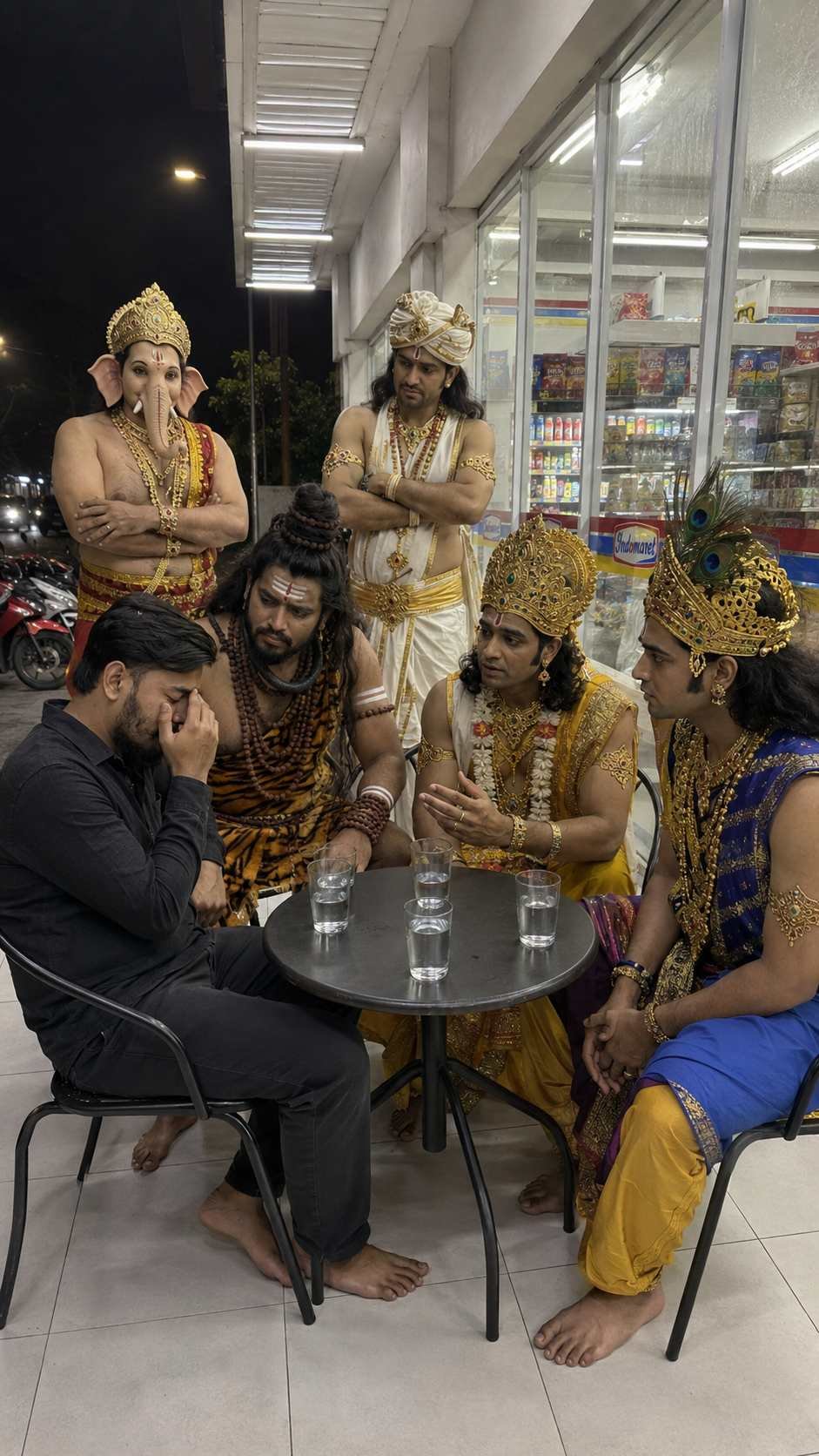
Nighttime outside a Southeast Asian convenience store. Bright fluorescent canopy lights overhead. Large glass windows revealing snack shelves, refrigerators, beverages, and convenience-store interior. Dark street with parked motorbikes and distant streetlights visible on the left. Clean tiled floor with subtle reflections. Realistic convenience-store atmosphere.
A small round metal table with several simple glasses of water. Casual metal chairs around the table.
The young Indian man from the reference image sits on the left side wearing the exact same black outfit seen in the reference photo. Completely barefoot. Leaning back slightly while crying emotionally, partially covering his face with one hand. Visible tears. Heartbroken expression.
Lord Shiva sits at the center, realistic human interpretation, long matted hair, rudraksha beads, tiger-print cloth, barefoot, leaning forward with concern and disappointment, focused entirely on the crying man.
Lord Vishnu sits on the right side, realistic human appearance, elegant traditional attire and ornaments, barefoot, calmly explaining something with gentle hand gestures.
Lord Krishna sits nearby, realistic human appearance, peacock feather crown, refined traditional clothing, elegant jewelry, barefoot, compassionate expression, comforting the crying man.
Lord Ganesha stands behind the group, realistic divine interpretation, traditional attire, barefoot, arms crossed, serious attentive expression.
Lord Balarama stands beside him, traditional attire, barefoot, calm wise expression, listening carefully.
Natural emotional interaction. Nobody posing. Nobody looking at camera. Feels like close friends helping someone through a difficult moment. Genuine late-night gathering atmosphere. Photojournalistic realism. Real skin texture, pores, imperfections, natural shadows, uneven fluorescent lighting, realistic white balance, handheld smartphone perspective, eye-level framing, authentic candid moment.
Negative Prompt:
cartoon, anime, manga, illustration, painting, digital art, CGI, 3D render, unreal engine, octane render, fantasy artwork, game character, plastic skin, doll face, beauty filter, AI-generated appearance, cinematic poster, movie poster, dramatic VFX, glowing aura, mystical effects, fantasy particles, overprocessed image, excessive sharpness, fake skin texture, distorted face, duplicate face, extra fingers, extra limbs, cropped feet, shoes, sneakers, sandals, slippers, socks, boots, flip-flops, studio lighting, professional photoshoot, looking at camera, watermark, logo, text, low quality, blurry face, unrealistic colors.
A Late-Night Candid Gathering: When Divine Figures Feel Like Close Friends
Some visual stories become powerful precisely because they feel unexpectedly ordinary. Instead of placing divine figures inside an elaborate celestial setting, this concept brings them into a familiar late-night environment—a small Southeast Asian convenience store, a metal table, simple glasses of water, parked motorbikes, fluorescent lights, and an emotional conversation between friends.
The unusual setting creates the central appeal of the concept. A young Indian man is sitting barefoot at a small table, visibly heartbroken and crying, while Shiva, Vishnu, Krishna, Ganesha, and Balarama gather around him. Nobody is posing for the camera. Nobody acknowledges the photographer. The entire scene is meant to feel like a private moment that happened to be captured spontaneously.
The Young Man at the Center of the Story
The young man is based on the uploaded reference image, with his recognizable facial identity remaining the foundation of the portrait.
His face, hairstyle, beard, jawline, eyes, eyebrows, nose, lips, skin tone, and facial proportions are intended to remain consistent with the reference.
However, the emotional situation is completely different from an ordinary portrait.
He sits on the left side of the table wearing the same black outfit from the reference photograph. He is completely barefoot, which immediately reinforces the informal and vulnerable nature of the scene.
His body leans slightly backward while one hand partially covers his face.
Tears are visible.
His expression communicates genuine heartbreak rather than theatrical sadness.
The most important aspect is restraint. The scene should not feel like an actor performing sadness for a camera. His posture, hand placement, lowered face, and visible tears should collectively suggest someone who has temporarily lost his emotional composure.
The Convenience Store at Night
The setting is intentionally ordinary.
Instead of a temple, palace, forest, or celestial environment, the group sits outside a Southeast Asian convenience store late at night.
Bright fluorescent canopy lights illuminate the area from above.
Through the large glass windows, the store interior remains visible, including snack shelves, refrigerators, beverage displays, and other everyday products.
This mundane environment is what makes the concept unusual.
The divine figures are not surrounded by clouds or heavenly architecture. They are sitting outside a neighborhood convenience store, sharing an emotionally difficult moment with someone who needs support.
That contrast creates a form of visual storytelling that feels both surreal and strangely familiar.
The Fluorescent Lighting
The lighting is deliberately imperfect.
Fluorescent canopy lights create uneven illumination across the table, chairs, people, and tiled floor.
Unlike professional studio lighting, the light does not perfectly flatter every face.
Some areas may be slightly brighter than others, while shadows appear naturally beneath the table, chairs, and bodies.
This imperfection is important because the scene is supposed to resemble a genuine smartphone photograph.
The lighting should therefore feel practical rather than cinematic.
The Dark Street
Beyond the convenience store, the surrounding street fades into darkness.
Parked motorbikes are visible toward the left, while distant streetlights create small points of illumination.
This establishes the time of day without needing any text.
The dark street also provides a natural contrast to the brightly illuminated convenience-store entrance.
The result is an environment that feels unmistakably late-night: bright artificial light in one small area surrounded by darkness.
The Small Metal Table
At the center is a simple round metal table.
There is nothing luxurious about it.
Several ordinary glasses of water sit on its surface, creating an understated sense of a group that has been sitting together for some time.
The glasses can contain small reflections from the fluorescent lights.
Subtle condensation or water marks can add further realism.
The table becomes the physical point around which the emotional conversation takes place.
Casual Metal Chairs
Simple metal chairs surround the table.
Their design should feel practical and slightly utilitarian, matching the convenience-store environment.
They should not resemble luxury restaurant furniture.
This ordinary furniture reinforces the concept’s central idea: extraordinary characters experiencing an extremely ordinary human situation.
Shiva’s Role
Lord Shiva occupies the center of the group.
He is represented as a realistic human interpretation rather than a heavily stylized fantasy character.
His long matted hair, Rudraksha beads, tiger-print cloth, and barefoot appearance establish his traditional visual identity.
But the most important detail is his body language.
He leans forward with concern and disappointment, focusing entirely on the crying man.
Rather than staring dramatically into the distance, Shiva appears engaged in the conversation.
His expression suggests that he cares about what has happened but may also be disappointed by the man’s situation or choices.
This gives the character emotional complexity.
He is not simply a symbolic figure placed in the frame. He appears to be participating in the conversation like someone who genuinely knows the person sitting beside him.
Vishnu’s Gentle Explanation
Lord Vishnu sits on the right side of the table.
His appearance is traditionally inspired, with elegant clothing and ornaments, but the overall treatment remains realistic and grounded.
He calmly explains something using gentle hand gestures.
This creates a visual contrast with Shiva’s concerned demeanor.
Where Shiva appears emotionally engaged and serious, Vishnu appears patient and measured.
His gestures should remain subtle—perhaps one hand raised slightly while explaining an idea, or an open palm emphasizing reassurance.
The interaction should feel conversational rather than ceremonial.
Krishna’s Compassion
Lord Krishna sits nearby, focused on comforting the young man.
His peacock feather crown, refined traditional clothing, and jewelry establish his identity, while his compassionate expression communicates emotional warmth.
Krishna’s role in the composition is less about giving a speech and more about providing reassurance.
His posture can lean slightly toward the young man, suggesting attentive listening.
The relationship between them should feel personal.
The visual idea is that Krishna is not simply appearing as a distant divine figure; he is present in the moment, listening to someone who is hurting.
Ganesha Standing Behind Them
Lord Ganesha stands behind the seated group.
His realistic divine interpretation maintains traditional clothing and a barefoot appearance.
His arms are crossed, and his expression is serious and attentive.
This creates an interesting visual personality.
While the others are directly involved in the conversation, Ganesha appears to be observing everything carefully from behind.
His serious expression can suggest that he understands the situation but is waiting for the right moment to speak.
The placement also gives the composition additional vertical structure.
Balarama as the Quiet Observer
Lord Balarama stands beside Ganesha.
His traditional attire and calm expression make him visually distinct without drawing attention away from the seated group.
His role is primarily that of a quiet listener.
He appears to be taking in the conversation with patience and wisdom.
This helps create the impression that the entire group has gathered specifically because the young man’s emotional situation matters to them.
Nobody Looks at the Camera
One of the most important photographic choices is that nobody looks directly toward the camera.
This single decision dramatically changes the feeling of the image.
If everyone stared at the lens, the photograph would immediately feel staged.
Instead, every person remains engaged with the situation.
The young man looks downward or covers his face.
Shiva looks toward him.
Vishnu looks toward the conversation.
Krishna focuses on comforting him.
Ganesha and Balarama observe the group.
The camera therefore becomes an unnoticed witness.
The Feeling of Close Friends
The emotional goal is to make the group feel like close friends supporting someone through a difficult night.
Their body language should be relaxed.
Nobody should stand unnaturally straight.
Nobody should display exaggerated theatrical gestures.
The conversation should appear spontaneous.
There may be small variations in posture, hand position, facial expression, and attention.
These imperfections make the scene feel human.
The Barefoot Detail
The barefoot requirement is unusually important.
The young man, Shiva, Vishnu, Krishna, Ganesha, and Balarama all remain barefoot.
This creates a subtle visual connection among the characters.
The absence of shoes also reinforces the informal atmosphere and distinguishes the scene from a conventional fashion or travel photograph.
The tiled floor should show realistic contact between the feet and the ground, including natural shadows.
Feet should remain anatomically believable and fully integrated into the scene.
Documentary Smartphone Aesthetic
The entire photograph follows the visual language of a raw smartphone snapshot.
It should not look like a polished movie poster.
There is no elaborate studio lighting.
There is no artificial HDR treatment.
There is no dramatic cinematic color grade.
Instead, the image should retain subtle smartphone imperfections:
- Natural grain
- Slight motion blur
- Uneven fluorescent exposure
- Realistic white balance
- Handheld perspective
- Mild photographic noise
- Natural contrast
- Small imperfections in sharpness
These characteristics help the photograph feel captured rather than manufactured.
Why the Lack of Cinematic Effects Matters
The concept specifically avoids glowing auras, mystical particles, dramatic VFX, fantasy lighting, and other supernatural visual effects.
This is essential to the storytelling.
The scene is already extraordinary because of who is sitting at the table.
Adding glowing halos or magical effects would actually weaken the concept by making it look like fantasy artwork.
The more ordinary the environment remains, the more interesting the divine presence becomes.
Emotional Realism
The most difficult part of this concept is not the convenience store or the clothing.
It is making the interaction emotionally believable.
The young man’s tears need to feel connected to the group’s reactions.
Shiva’s concern should appear directed toward him.
Vishnu’s explanation should feel like an actual response to the situation.
Krishna’s expression should communicate empathy.
Ganesha and Balarama should appear genuinely attentive.
This creates a chain of emotional relationships rather than six independent characters placed into one frame.
The Nighttime Atmosphere
Late-night surroundings naturally create intimacy.
The convenience store is brightly illuminated, but the surrounding road remains dark.
The group sits in this small island of light.
Motorbikes are parked nearby.
Distant streetlights glow faintly.
The tiled floor reflects small amounts of artificial light.
Everything suggests that the world outside has become quiet while this conversation continues.
This gives the scene a private, almost confessional quality.
The Deeper Symbolism
At its heart, the concept can be interpreted as a visual metaphor for having support during emotional hardship.
The young man is physically surrounded by figures representing wisdom, compassion, strength, patience, and guidance.
Yet the scene avoids presenting them as distant supernatural beings.
Instead, they appear as companions.
That makes the emotional message more accessible.
The central idea becomes:
When someone is struggling, they need someone willing to sit beside them—not necessarily someone who immediately fixes everything.
The Contrast Between the Ordinary and the Divine
This contrast is the concept’s greatest strength.
A convenience store is ordinary.
A metal table is ordinary.
A glass of water is ordinary.
A dark street is ordinary.
A crying person is ordinary.
But the people gathered around him are extraordinary.
That combination creates an unusual visual narrative where the divine becomes part of everyday life rather than something separated from it.
Final Visual Impression
The completed concept is envisioned as a raw, emotionally honest late-night smartphone photograph.
A young man sits barefoot outside a brightly lit convenience store, visibly heartbroken.
Around him, Shiva, Vishnu, Krishna, Ganesha, and Balarama gather—not as distant supernatural characters, but as concerned companions.
There are no dramatic poses.
No one looks at the camera.
There are no glowing effects.
There is only a small table, a few glasses of water, fluorescent light, a quiet street, and a difficult conversation.
That simplicity is what gives the concept its emotional power.
The photograph ultimately tells a human story disguised as an extraordinary one: someone is hurting, and the people who care about him have simply chosen to stay.