Prompt Content
REFERENCE IMAGE STRENGTH 100 | FACE ID LOCK 100 | CHARACTER CONSISTENCY 100 | IDENTITY PRESERVATION MAXIMUM
Use the uploaded image as the exact identity reference. Preserve 100% facial identity, face shape, jawline, beard style, mustache, hairstyle, hairline, eyebrows, eyes, nose, lips, skin tone, ears, and overall appearance. Do not alter age, ethnicity, or facial structure.
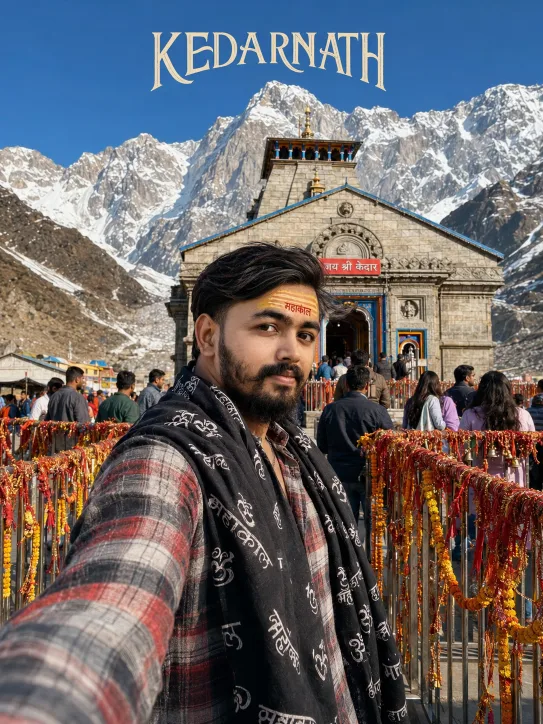
Ultra-realistic 8K cinematic wide-angle smartphone selfie of the same young man standing in front of the sacred Kedarnath Temple, holding the camera with an extended arm. Exact face match from reference image. Soft confident smile, natural expression, detailed facial hair and realistic skin texture.
Traditional yellow sandalwood Tripund Tilak (three horizontal lines) on the forehead with bright red Hindi text “महाकाल” written across it. Wearing a luxurious black devotional shawl draped over the shoulders, covered with intricate white Sanskrit “महाकाल” calligraphy and Om (ॐ) symbols. Under the shawl, a premium red, white, and muted gray plaid flannel shirt with realistic cotton texture, rolled sleeves, slightly open collar, natural folds and wrinkles, thin silver chain necklace visible.
Background: Majestic Kedarnath Temple constructed from ancient weathered gray stone. Above the entrance, a red sign displaying “जय श्री केदार” in white Hindi text. Temple surroundings decorated with vibrant marigold garlands, sacred red religious threads tied to metal barricades. Large crowd of pilgrims creating an authentic pilgrimage atmosphere.
Behind the temple, towering snow-covered Himalayan mountains under a crystal-clear deep blue sky. Bright natural daylight with warm golden highlights, cinematic HDR lighting, ultra-detailed textures, realistic shadows, depth of field, vibrant colors, sharp focus on the face and tilak.
Professional smartphone camera quality, Instagram-worthy travel photography, photorealistic, hyper-detailed, ultra-sharp, DSLR-level realism, devotional atmosphere, breathtaking mountain scenery, masterpiece quality, 8K resolution.
Aspect Ratio: 3:4
A Cinematic Kedarnath Selfie: Faith, Identity, and the Majesty of the Himalayas
A travel photograph can capture a destination, but a truly memorable image captures the relationship between a person and a place. This concept transforms a simple smartphone selfie into a cinematic pilgrimage portrait, placing a young man directly in front of the sacred Kedarnath Temple while surrounding him with devotional symbolism and the dramatic beauty of the Himalayan landscape.
The visual story combines personal identity, modern smartphone photography, traditional Shaivite elements, pilgrimage culture, and mountain grandeur. Although the image is designed with an extremely polished cinematic aesthetic, its emotional foundation remains simple: a young man standing in a sacred place with a quiet smile, documenting a meaningful moment.
Identity as the Heart of the Portrait
The uploaded image serves as the exact identity reference for the young man.
His recognizable facial characteristics—including face shape, jawline, beard, mustache, hairstyle, hairline, eyebrows, eyes, nose, lips, ears, skin tone, and overall facial structure—are intended to remain consistent.
This is particularly important for a selfie because the viewer’s attention naturally goes directly toward the face.
The goal is not to transform the individual into a generic travel model. The clothing, location, lighting, and devotional styling can change, but the person’s recognizable appearance remains the foundation of the photograph.
His age and natural facial proportions should also remain believable, avoiding unnecessary beautification or artificial facial changes.
The Smartphone Selfie Perspective
The image is envisioned as a wide-angle smartphone selfie captured with the man’s arm extended toward the camera.
This perspective immediately makes the composition feel personal.
Instead of looking like a professional photographer took the photograph from several meters away, the viewer feels as though they are standing alongside the subject at Kedarnath.
The extended arm also establishes the physical relationship between the camera and the subject.
A successful selfie perspective needs to retain realistic proportions. Wide-angle smartphone cameras naturally create some perspective distortion, but the face should remain recognizable and anatomically believable.
The composition should therefore feel like a high-end smartphone travel photograph rather than an artificially constructed studio portrait.
The Confident Smile
The man’s expression is intentionally subtle.
A soft, confident smile communicates happiness without becoming exaggerated.
He appears genuinely pleased to be standing at such a significant location.
The expression should remain natural, with relaxed eyes and believable facial muscles. The photograph should capture the feeling of someone enjoying a meaningful travel moment rather than someone posing excessively for the camera.
This small expression becomes especially important because the surrounding environment is visually enormous.
The face provides the personal and emotional anchor.
The Mahakal Tripund Tilak
A traditional yellow sandalwood Tripund tilak adorns the man’s forehead.
The three horizontal lines create an immediately recognizable Shaivite visual element.
Across the tilak appears the bright red Hindi word:
“महाकाल”
The marking should appear naturally applied to the forehead, with slight variations in texture and edges rather than looking like digitally overlaid typography.
The combination of yellow sandalwood and red lettering creates a strong contrast against the man’s skin and draws attention toward the face.
It also establishes the devotional character of the portrait before the viewer even notices the larger temple environment.
The Black Mahakal Shawl
The man’s black devotional shawl is another major visual feature.
It is draped naturally over his shoulders and covered with intricate white Sanskrit “महाकाल” calligraphy and ॐ symbols.
The dark fabric creates a strong contrast against the bright Himalayan background.
The white devotional patterns provide additional visual texture while reinforcing the spiritual theme.
The shawl should behave like real fabric, with natural folds around the shoulders and chest. Its weight and draping should be physically believable.
This is important because the image combines fashion styling with documentary-style travel photography.
The Modern Plaid Shirt
Underneath the devotional shawl, the subject wears a premium red, white, and muted-grey plaid flannel shirt.
This introduces a contemporary casual element into the otherwise traditional styling.
The shirt features rolled sleeves and a slightly open collar, allowing a thin silver chain necklace to remain visible.
Its cotton texture should be realistic, with natural wrinkles and folds around the arms, shoulders, chest, and waist.
The plaid pattern also provides a subtle geometric contrast to the more organic shapes of the shawl’s Sanskrit calligraphy and the surrounding temple decorations.
Kedarnath Temple as the Main Landmark
Behind the young man stands the magnificent Kedarnath Temple.
Its ancient weathered grey stone architecture establishes the historical and spiritual identity of the scene.
The stone should display realistic texture, including subtle variations in color, weathering, joints, carvings, and surface imperfections.
Rather than appearing like a generic stone building, the temple should have a monumental presence.
Its placement behind the subject creates a natural visual hierarchy:
Person → Temple → Himalayas → Sky
This structure allows the photograph to communicate both the personal experience and the scale of the destination.
The “जय श्री केदार” Sign
Above the temple entrance is a red sign displaying:
“जय श्री केदार”
in white Hindi lettering.
The sign becomes a small but highly meaningful contextual detail.
Its red color also connects visually with the red elements in the subject’s plaid shirt, the sacred threads, and the warm devotional decorations.
Because text can easily become distorted in generated imagery, the lettering needs to appear clear, correctly formed, and naturally integrated into the architecture.
Marigold Garlands and Sacred Threads
The temple surroundings are decorated with vibrant marigold garlands.
Their yellow and orange tones introduce warmth into an environment dominated by grey stone and cool mountain colors.
Sacred red threads tied around metal barricades add another layer of cultural detail.
These small environmental elements help transform the scene from a generic mountain photograph into an authentic pilgrimage setting.
The decorations should appear naturally placed rather than perfectly arranged for the camera.
That slight visual irregularity can actually make the environment feel more realistic.
The Crowd of Pilgrims
A large crowd of pilgrims surrounds the temple.
Their presence is essential for establishing scale.
Without people, the temple might feel like an isolated architectural monument. With pilgrims moving through the surroundings, the viewer understands that this is an active spiritual destination.
The crowd should remain secondary to the main subject.
Individual background figures can be slightly softer due to depth of field, while their clothing, movement, and general appearance contribute to the authenticity of the pilgrimage atmosphere.
The goal is to create a believable sense of activity without allowing background faces to compete with the main subject.
The Himalayan Mountains
Beyond the temple rise towering snow-covered Himalayan mountains.
These mountains dramatically expand the scale of the composition.
The temple represents human architecture and centuries of spiritual tradition, while the mountains represent the immense natural landscape surrounding it.
Snow-covered peaks provide a spectacular contrast against the darker stone architecture.
Their distant surfaces should retain realistic atmospheric depth, becoming slightly softer with distance while remaining clearly recognizable.
The Deep Blue Himalayan Sky
A crystal-clear deep blue sky occupies the upper portion of the composition.
The clean sky provides a strong visual backdrop for the temple and mountains.
Bright daylight creates natural highlights across the stone architecture, the subject’s face, and the surrounding snow.
The clear atmosphere also reinforces the feeling of being high in the Himalayas.
Rather than creating an overly dramatic fantasy sky, the concept relies on the natural beauty of the mountain environment.
Warm Golden Highlights
Although the overall environment contains cool blues and greys, warm golden highlights add balance.
Sunlight can gently illuminate the man’s face, the temple stone, marigold flowers, and selected architectural details.
This warm light creates a pleasant contrast against the deep blue sky and snowy mountains.
The result is a color palette that feels vibrant but still believable:
- Deep blue sky
- Cool grey temple stone
- White snow
- Warm yellow and orange marigolds
- Red devotional elements
- Black shawl
- Red and grey plaid shirt
Together, these colors create a strong travel-photography composition.
Smartphone Photography With Professional Quality
Although the scene is described as smartphone photography, the visual quality is intended to approach professional DSLR-level realism.
Modern smartphone cameras can produce remarkably detailed photographs, particularly under strong daylight.
The image should therefore combine the convenience and perspective of a selfie with excellent dynamic range, sharp facial detail, realistic exposure, and natural colors.
The face and tilak remain the primary sharp areas, while distant elements gradually soften according to natural photographic depth.
Realistic Skin and Facial Hair
Facial realism is especially important because the selfie places the man’s face close to the camera.
The skin should retain subtle pores, natural texture, and realistic tonal variation.
His beard and mustache should maintain individual hair detail without appearing artificially sharpened.
Eyebrows, eyelashes, hairline, and small facial characteristics should remain consistent with the reference identity.
The objective is not flawless skin.
It is believable skin.
Small natural variations help the portrait feel like an authentic photograph.
Realistic Lighting and Shadows
The sunlight should produce physically believable shadows.
The man’s face, shawl, shirt, and body should all respond naturally to the same environmental light.
The temple should receive illumination consistent with its position relative to the sun.
Likewise, the pilgrims, barricades, garlands, and surrounding surfaces should share the same lighting conditions.
This consistency is critical because mismatched shadows are one of the quickest ways to make a photorealistic scene appear artificial.
Depth of Field
The image uses controlled depth of field to emphasize the young man’s face while preserving the identity of the location.
The foreground subject remains highly detailed.
The temple remains recognizable and sufficiently sharp.
The distant crowd and mountains can become progressively softer as they move farther from the camera.
This creates a realistic photographic hierarchy without turning the entire background into an artificial blur.
The 3:4 Vertical Composition
The 3:4 aspect ratio is well suited to the concept because it accommodates the subject’s upper body, the temple behind him, and enough vertical space for the Himalayan mountains and sky.
The composition should avoid cropping important facial features or devotional elements.
The man’s face should remain prominent while the temple entrance and mountain peaks remain visible.
This balance is essential: the photograph needs to function simultaneously as a personal selfie and a recognizable Kedarnath travel photograph.
The Emotional Meaning
At its deepest level, the portrait is about more than visiting a famous destination.
The young man’s expression, folded devotional styling, tilak, and Mahakal shawl communicate a personal connection with the spiritual atmosphere.
The temple provides historical and religious context.
The mountains provide grandeur.
The selfie provides intimacy.
That combination makes the scene feel like a personal memory rather than simply a tourist photograph.
Final Visual Impression
The finished concept represents a modern devotional travel portrait at Kedarnath, combining personal identity with one of India’s most dramatic spiritual landscapes.
The young man’s recognizable face remains the emotional center.
His soft smile conveys confidence and happiness.
The Tripund tilak and Mahakal shawl establish his devotional connection.
The modern plaid shirt keeps the styling contemporary.
Behind him, the weathered stone temple, marigold garlands, sacred threads, pilgrims, snow-covered mountains, and deep blue Himalayan sky create an expansive sense of place.
The strongest version of the photograph would avoid excessive artificial effects and instead rely on realistic daylight, natural skin texture, believable clothing, authentic environmental details, and carefully controlled smartphone-camera perspective.
Ultimately, the image tells a simple story: a personal moment of faith and happiness captured against the timeless architecture of Kedarnath and the breathtaking presence of the Himalayas.