Prompt Content
REFERENCE IMAGE STRENGTH 100 | FACE ID LOCK 100 | IDENTITY PRESERVATION MAXIMUM | CHARACTER CONSISTENCY 100
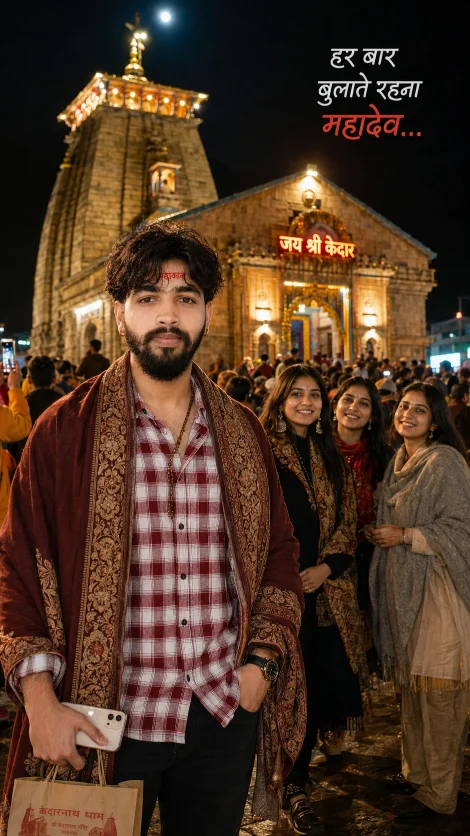
Create an ultra-realistic 8K cinematic devotional portrait at Kedarnath Temple, Uttarakhand, India during night time. Use the uploaded reference image as the exact facial identity source. Preserve the same hairstyle, face shape, eyes, eyebrows, beard pattern, skin texture, nose, lips, jawline, ears, expression, and overall appearance with maximum accuracy.
A handsome young Indian man (22–23 years old, 5’11”, athletic build) stands prominently in the foreground slightly left of center. He has medium-length voluminous black wavy hair, expressive brown eyes, attractive facial symmetry, naturally groomed beard and moustache, realistic skin pores, and a calm devotional expression while looking directly into the camera.
Outfit:
- Red and white checkered shirt
- Black denim jeans
- Elegant maroon Kashmiri embroidered shawl draped over shoulders
- Intricate golden floral embroidery along shawl borders
- Black metallic wristwatch on left wrist
- Small rudraksha bead necklace
- White smartphone held naturally in one hand
- Traditional red Hindi “महाकाल” tilak on forehead
- Kedarnath temple prasad paper bag in hand
Pose:
- Relaxed standing posture
- One hand partially inside pocket
- Looking directly at camera
- Soft confident smile
- Natural body language
Background:
Authentic Kedarnath Temple illuminated at night with highly detailed stone architecture. Bright golden temple floodlights create a divine atmosphere. The glowing “जय श्री केदार” signboard shines above the entrance. Massive gathering of pilgrims fills the courtyard. Devotees taking photographs with smartphones. Realistic crowd depth and perspective.
Three young Indian women stand behind the main subject:
- Long black hair
- Small red bindis
- Traditional winter festive clothing
- Natural smiles
- One woman wearing black dress with patterned brown shawl
- Looking toward camera
Environment:
- Wet stone courtyard with realistic reflections
- Cold Himalayan night atmosphere
- Deep black sky
- Subtle moon glow near temple spire
- Warm golden temple lighting
- Spiritual pilgrimage ambience
- Fine mist in the air
- HDR night photography details
Text in upper-right corner:
“हर बार बुलाते रहना महादेव…”
Lighting:
- Professional cinematic night photography
- Temple floodlights illuminating subject naturally
- Balanced exposure between subject and temple
- Soft shadows
- Realistic light falloff
- Warm highlights on face
- Photorealistic skin rendering
Camera:
- Full-frame DSLR
- 50mm lens
- f/1.8 aperture
- HDR night photography
- Shallow depth of field
- Ultra-sharp focus on subject
- Slightly softened crowd background
- Luxury travel editorial style
- Bollywood devotional cinematic aesthetic
- Unreal Engine 5 realism
- Photorealistic rendering
- Magazine-quality composition
- Spiritual tourism campaign photography
- Masterpiece, best quality, ultra detailed, 8K, hyper realistic, cinematic color grading.
Kedarnath at Night: A Devotional Portrait of Faith, Presence, and the Call of Mahadev
This concept is designed as a cinematic devotional travel portrait in which the young man becomes the emotional foreground while the illuminated Kedarnath Temple creates the spiritual and architectural backdrop.
The strongest aspect of the composition is the contrast between the intimate portrait of the individual and the enormous pilgrimage atmosphere behind him. Rather than presenting the temple as a distant landmark, the scene makes it feel alive—with pilgrims, lights, smartphones, wet stone, mist, and the quiet intensity of a Himalayan night.
The Face and Personal Identity
The uploaded reference image acts as the primary identity source for the young man.
His recognizable characteristics—including hairstyle, facial proportions, eyes, eyebrows, beard, moustache, nose, lips, jawline, ears, skin texture, and overall appearance—are intended to remain consistent.
This is important because the portrait is fundamentally personal.
The surrounding elements can change dramatically—traditional clothing, nighttime lighting, Kedarnath, devotional styling—but the central individual should still look unmistakably like the same person.
The expression is calm and devotional rather than exaggerated. His direct gaze toward the camera creates a personal connection with the viewer.
The Young Man as the Foreground Subject
The man stands slightly left of center, giving the temple enough visual space to remain clearly visible behind him.
His athletic build and approximately 5’11” stature contribute to a confident full-body silhouette.
His medium-length black wavy hair adds volume around the head and creates attractive separation against the darker nighttime background.
His brown eyes remain expressive, while the naturally groomed beard and moustache preserve a realistic masculine appearance.
The soft smile is intentionally restrained.
He looks comfortable and peaceful, as though he has just arrived at a place that carries personal spiritual significance.
The Traditional Outfit
The clothing combines modern casual fashion with traditional Himalayan devotional styling.
He wears a red-and-white checkered shirt beneath a rich maroon Kashmiri embroidered shawl.
The checkered shirt introduces a familiar everyday element, while the shawl immediately elevates the appearance and connects the subject to the cold mountain environment.
The black denim jeans provide a neutral foundation.
Together, the outfit feels contemporary rather than costume-like.
The Maroon Kashmiri Shawl
The maroon shawl is one of the strongest fashion elements in the composition.
Its rich color works particularly well under the warm golden temple lighting.
Golden floral embroidery runs along the borders, adding intricate detail and a subtle luxury aesthetic.
The fabric should fall naturally over the shoulders with realistic folds, weight, and texture.
Rather than appearing perfectly arranged, the shawl should have the slight irregularity expected from something actually being worn outdoors.
Devotional Accessories
A small Rudraksha bead necklace introduces a subtle religious element without overwhelming the outfit.
The black metallic wristwatch adds a modern contrast.
The traditional red Hindi “महाकाल” tilak on the forehead becomes the primary devotional detail on the face.
Because the subject is looking directly into the camera, the tilak becomes naturally prominent.
The tilak should look hand-applied and slightly imperfect rather than resembling digitally printed text.
The Smartphone and Prasad Bag
The white smartphone provides a modern connection to the surrounding pilgrims, many of whom are also documenting their journey.
This is an important storytelling detail.
The scene is not portraying spirituality as something disconnected from contemporary life.
People are visiting an ancient sacred site while using modern technology to capture their experiences.
The Kedarnath temple prasad paper bag adds another layer of authenticity, suggesting that the subject has actively participated in the pilgrimage rather than simply posing at a tourist landmark.
The Direct Gaze
The subject looks directly toward the camera.
This makes the image feel personal and immediate.
Instead of appearing distracted by the temple or crowd, he appears to deliberately capture this particular moment.
His soft confident smile creates a balance between devotion and happiness.
The result should feel like a genuine travel memory rather than an overly dramatic religious poster.
Kedarnath Temple at Night
The Kedarnath Temple forms the visual heart of the background.
Its ancient grey stone architecture becomes particularly dramatic after sunset.
Golden floodlights illuminate the temple structure, revealing its stone surfaces and architectural details while separating it from the deep black Himalayan sky.
The contrast between illuminated stone and surrounding darkness gives the temple an almost monumental presence.
The architecture should remain grounded in realistic stone textures, weathering, carvings, joints, and natural imperfections.
The “जय श्री केदार” Sign
Above the entrance, the glowing sign:
“जय श्री केदार”
provides an unmistakable devotional context.
Its illuminated appearance can become one of the brightest points in the background.
However, the light should remain physically believable.
It should cast subtle illumination around the entrance rather than becoming an artificial glowing object.
The Pilgrimage Crowd
The courtyard is filled with pilgrims.
Some devotees are walking.
Others are standing together.
Some are taking photographs with smartphones.
This crowd transforms the temple from a static architectural background into a living pilgrimage environment.
The crowd should have realistic depth.
People closer to the camera can be more recognizable, while those farther away become progressively softer.
This creates a convincing sense of scale.
The main subject remains visually dominant even though the background is full of activity.
The Three Women Behind the Subject
Three young Indian women appear behind the main subject.
They have long black hair and small red bindis, wearing traditional winter festive clothing appropriate for the cold Himalayan environment.
One wears a black dress with a patterned brown shawl.
Their natural smiles introduce warmth into the composition.
They look toward the camera, creating a subtle connection between the foreground subject and the group behind him.
Their placement should remain secondary so they support the travel-story atmosphere without competing with the main subject.
The Wet Stone Courtyard
The courtyard has recently been exposed to moisture, leaving the stone surface wet.
This becomes a major photographic advantage at night.
Golden temple lighting reflects across the damp stone.
Small reflections from people, lights, and architectural elements appear irregularly across the surface.
The reflections should not be perfectly mirror-like because real stone is uneven.
Subtle puddles, variations in texture, and broken reflections make the environment more believable.
Himalayan Night Atmosphere
The sky is deep black, emphasizing the altitude and remoteness of the location.
A subtle moon glow appears near the temple spire.
Fine mist hangs in the cold air.
This creates atmospheric depth around the temple and crowd without obscuring the main subject.
The combination of darkness, mist, golden architecture, and wet stone produces a powerful nighttime pilgrimage atmosphere.
Warm Temple Light vs. Cold Mountain Night
The scene benefits from a natural warm-versus-cool contrast.
The surrounding Himalayan night is cold, dark, and blue-black.
The temple radiates warm golden illumination.
The subject sits between these two visual environments.
Warm light touches his face and shawl while the darker surroundings frame his silhouette.
This creates a sophisticated color relationship without requiring excessive visual effects.
Realistic Night Photography
Night photography presents a technical challenge because the scene contains both very bright lights and extremely dark areas.
The image therefore requires careful exposure.
The temple floodlights should remain bright without becoming completely blown out.
The black sky should retain a clean, deep appearance.
The man’s face should remain sufficiently illuminated to preserve skin detail.
The wet courtyard should retain reflections without becoming unnaturally bright.
This balance is what gives the scene a professional nighttime photographic appearance.
50mm Lens and Shallow Depth of Field
The 50mm lens perspective provides a natural-looking portrait relationship between the subject and the background.
The main subject remains sharply defined.
His eyes, facial hair, skin texture, shawl embroidery, and clothing details receive the greatest attention.
The crowd gradually softens into the distance.
Importantly, the temple remains recognizable.
An overly shallow depth of field could destroy the sense of location, so the background needs enough clarity to communicate that this is unmistakably Kedarnath.
The Upper-Right Message
The phrase:
“हर बार बुलाते रहना महादेव…”
appears in the upper-right area.
Its placement allows the text to complement the composition without covering the subject’s face or the most important architectural elements.
Emotionally, the sentence suggests an intimate relationship with Mahadev—a desire to return whenever the divine call comes.
The ellipsis at the end gives the statement an unfinished, reflective quality.
It feels less like an announcement and more like a personal thought.
Spiritual Tourism Aesthetic
The overall visual language combines devotional photography with premium travel editorial styling.
The temple establishes the spiritual destination.
The subject establishes the personal experience.
The clothing establishes cultural context.
The crowd establishes authenticity.
The mountains establish geographic grandeur.
The wet courtyard and nighttime lighting provide cinematic atmosphere.
This combination makes the portrait suitable for the visual language of a sophisticated spiritual tourism campaign.
Bollywood-Style Cinematic Influence
The Bollywood devotional influence comes primarily through composition and emotional atmosphere rather than exaggerated effects.
The warm temple illumination, expressive portrait, maroon shawl, dramatic nighttime environment, and devotional typography create a cinematic quality.
However, maintaining realistic skin, natural shadows, believable crowd behavior, and physically consistent lighting prevents the image from becoming an artificial movie poster.
The ideal result feels like a cinematic photograph from a devotional travel film.
Authenticity Over Excess
The biggest danger with this type of concept is overloading it with artificial effects.
Too much glow would make the temple look digitally generated.
Too much mist would hide the architecture.
Too much HDR would destroy the natural night atmosphere.
Too much color saturation would make the clothing and temple lights look unrealistic.
Too much facial retouching would weaken the identity.
The strongest interpretation is therefore relatively disciplined: realistic lighting, authentic textures, controlled color, natural expressions, and carefully managed atmosphere.
Composition and Visual Hierarchy
The viewer’s eye should naturally move through the image in this order:
Face → Tilak → Shawl → Temple → “जय श्री केदार” → Pilgrims → Himalayan night
The man’s face is the emotional anchor.
The red Mahakal tilak strengthens the devotional identity.
The embroidered shawl adds texture.
The temple establishes location.
The illuminated sign reinforces the spiritual context.
The crowd adds realism.
The dark mountains and sky provide the final sense of scale.
Final Visual Impression
The finished portrait would feel like a deeply personal moment captured during a Himalayan pilgrimage.
A young man stands calmly in the cold night, wearing a traditional embroidered shawl over contemporary clothing, holding his phone and prasad bag while looking directly into the camera.
Behind him, Kedarnath Temple glows beneath the darkness.
Pilgrims move through the courtyard.
Wet stone reflects the golden lights.
Fine mist floats through the cold air.
Snow-covered Himalayan surroundings disappear into the darkness.
And above the composition, the words “हर बार बुलाते रहना महादेव…” turn the photograph from a simple travel image into a personal devotional statement.
The strongest version would ultimately feel less like a staged religious poster and more like a treasured pilgrimage memory—one quiet moment between a person, Mahadev, and the timeless presence of Kedarnath.